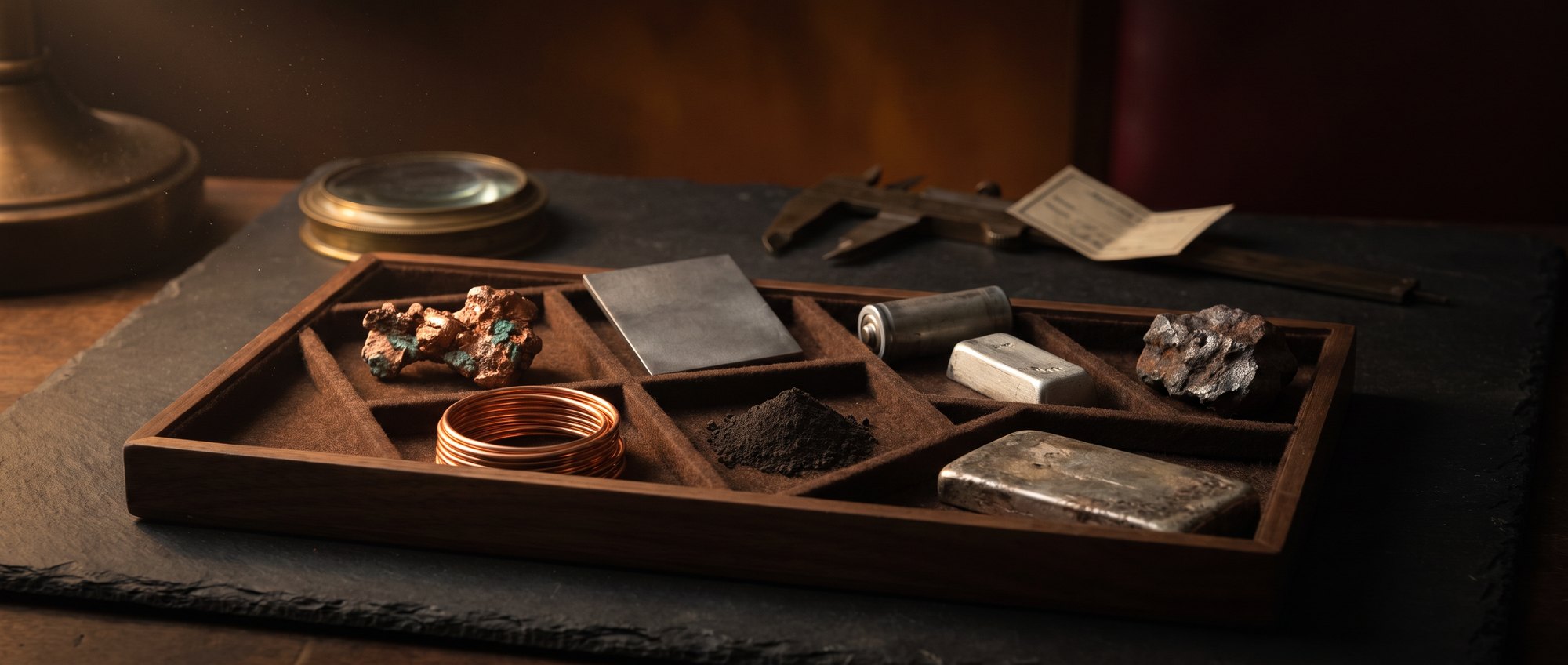
The other metals
Gold-O-Matic is about gold. This page is not.
It exists because the questions worth asking about gold turn out to be the most interesting questions to ask about any metal. Where does it come from. Who controls the supply. How is the price actually set. What would have to be true for it to behave like money. Most writing about critical minerals goes straight to forecasting the price. This does not.
Silver and platinum are on the main page, because those are the two people most often mistake for gold. Everything else lives here.
Nothing on this page is a recommendation, and none of it feeds the gauge.
Almost everything else on this page is priced by assessment, by private contract, or by whatever a government decided last month. Copper is not. It has traded on the London Metal Exchange since the nineteenth century, it trades on COMEX in New York and in Shanghai, and there is a continuous public quote anyone can look up. Deep liquidity, real price discovery, warehouse stocks published daily. It is worth seeing one industrial metal that works this way before assuming the way lithium is priced is normal.
That transparency is why it picked up a nickname. Doctor Copper is the idea that the copper price reads the health of the world economy, because copper goes into nearly everything that gets built — wiring, plumbing, motors, grid infrastructure, and now data centres. Gold gets read as a fear gauge. Copper gets read as a growth gauge. Neither nickname is a law of nature, but copper's is at least backed by a genuine market rather than by a survey of dealers.
The supply story is the most straightforward here and the least forgiving. Chile produces roughly a quarter of the world's mined copper, and ore grades across its ageing deposits have been falling for years, which means moving and processing more rock to get the same metal. A new deposit takes something like a decade to go from discovery to production. So the supply response to a high price is slow for entirely undramatic reasons. Nobody is withholding anything. That is simply how long it takes.
There are broadly two routes. Hard rock: spodumene ore is mined and crushed, mostly in Western Australia, in what looks like conventional mining. Brine: salty water is pumped from beneath salt flats into vast evaporation ponds and concentrated by sun and wind over many months, mostly in Chile's Atacama and across the border in Argentina. Same element, two almost unrelated industries. One is quarrying. The other is closer to farming.
It is concentrated. The USGS puts Australia, Chile and China together at more than 85% of world mine output, with Australia the largest producer and Chile holding the largest reserves.
Then comes the step most coverage skips. Neither ore nor pond concentrate is something a battery factory can use. It has to be converted into battery-grade lithium carbonate or lithium hydroxide, which is chemistry rather than mining, and most of that refining capacity sits in China. So the map of where lithium is dug up and the map of where it becomes usable are two different maps, and the second one is the more concentrated of the two.
The numbers are not close. The USGS Mineral Commodity Summaries put identified lithium resources at roughly 115 million tonnes of contained lithium and reserves at roughly 30 million tonnes, against world mine production of about 240,000 tonnes in 2024. Whatever the constraint is, it is not the amount of lithium in the ground.
The constraint is time, capital and permits. A new mine or a new refinery is measured in years, and it has to be financed on a guess about what the price will be when it opens. So "shortage" in this market almost always means "not arriving fast enough at a price buyers like", which is a different sentence from "we are running out".
The last cycle is the proof. Prices spiked, everybody announced a project, the supply eventually arrived, and prices fell far enough that mines were curtailed and projects were cancelled. That is an ordinary commodity cycle. It only looked extraordinary because the demand growth underneath it was extraordinary.
Recycling barely registers yet, and that is a fact about timing rather than technology. Almost all the gold ever mined still exists, which is why gold's above-ground stock is the whole market. The battery fleet is young, so most lithium ever mined is still sitting inside something that is still working. That stock will come back eventually, and it will change the supply picture when it does.
For most of its history there was no continuous public quote for lithium at all. It was sold under bilateral contracts between producers and battery makers, and the reference number everyone used came from price reporting agencies such as Fastmarkets, which survey deals and publish an assessment. That is a considered judgement about a market, not a printed clearing price.
It is also priced per tonne of a chemical compound rather than per ounce of metal, and the two main compounds do not move in lockstep. Battery-grade lithium carbonate and battery-grade lithium hydroxide are different products with different buyers. So "the lithium price" is an ambiguous phrase in a way that "the gold price" is not.
Futures arrived late, and mostly not in the West. The Guangzhou Futures Exchange launched lithium carbonate futures in July 2023 and opened them to overseas traders in July 2026. The CME contract settles financially against an assessed price rather than delivering anything. Benchmark authority tends to settle where the buying is, and for lithium the buying is in China.
The volatility is on a different scale from anything on this gauge. Battery-grade lithium carbonate peaked above 590,000 yuan a tonne in November 2022 and was trading at under a third of that by the middle of 2026. Gold's worst decade looks placid beside it.
Lithium is not the whole story, and which other metals matter is decided by the cathode chemistry. Nickel-manganese-cobalt and nickel-cobalt-aluminium cells use both nickel and cobalt. Lithium iron phosphate cells use neither, and LFP passed half of global electric vehicle battery installations in 2025. A decision taken in a battery designer's spreadsheet can remove demand for an entire metal.
That is a different kind of risk from the ones a mine usually faces. There is no substitute for copper in a wire, so a copper deposit does not much care what engineers decide. A cobalt mine does. Demand for these metals is contingent on an engineering choice that gets revisited every product cycle, and the choice is made years before it shows up in a price.
The thread running through all of it is that these prices are set by contracts, chemistry decisions and government policy at least as much as by anything that looks like an open market.
Ask what a lithium-ion battery is made of and most people say lithium. By weight the anode is usually the single biggest component, and the anode is mostly graphite. Anode material typically runs somewhere between fifteen and thirty per cent of a cell's weight, a good deal more than the lithium in it.
Supply is more concentrated than lithium's, not less. The USGS puts China at roughly seventy-eight per cent of natural graphite mine production, and the United States produced none at all in 2024. But mining is again the less concentrated half of the story. China's share of the spherical purified graphite and the synthetic anode material that batteries actually need is higher still.
There are two graphites, which trips people up. Natural graphite is mined and then purified into a spherical form. Synthetic graphite is manufactured from petroleum coke in a furnace process so energy-hungry that it is, like aluminium, largely an electricity bill wearing a different hat. Battery makers use both. China introduced export controls on certain graphite products in 2023, which is roughly when everyone outside the industry learned it existed.
Cobalt is the most geographically concentrated metal on this page. The Democratic Republic of the Congo accounts for roughly seventy per cent of world mine production, a degree of concentration you will not find in oil, or wheat, or much else the world runs on.
And most cobalt anywhere is not mined for its own sake. It comes out of the ground attached to copper or nickel, as a by-product, which means the people producing most of the world's cobalt are making their decisions based on the copper price. A high cobalt price does far less to bring on new supply than it would in a market where somebody was actually mining cobalt on purpose. That is the same by-product logic that governs silver, arriving at a very different metal.
Put those two facts together and policy stops being a footnote to the market and becomes part of it. When the DRC introduced export restrictions in 2025 the price moved hard, because there was no second source at scale and no price signal capable of conjuring one quickly. There is no deep futures market either, so cobalt is priced by assessment and negotiated contract, like lithium and unlike copper.
For most of its history Indonesia dug up nickel ore and shipped it abroad to be processed, capturing the smallest share of the value along the way. In 2020 it banned exports of unprocessed ore outright, so anyone who wanted Indonesian nickel had to build smelters in Indonesia.
It worked. Investment followed, processing capacity went up, and within a few years Indonesia had become the dominant producer of refined nickel and not merely of ore. One government redrew the global supply map deliberately, inside a decade, using a trade rule and nothing else.
That is worth sitting with, because it cuts against the instinct that commodity markets are something like weather. They are not. They are arrangements, and arrangements have authors. Whether the policy was good for Indonesia, or for the nickel price, or for anyone buying nickel, is a separate argument from whether it worked. It plainly worked.
The lithium cards say recycling barely registers so far, and that this is a fact about timing rather than technology. Lead is what the far end of that timeline looks like.
Lead-acid batteries account for the great majority of world lead consumption, and they come back. The USGS puts secondary lead at about a million tonnes in the United States in 2025, roughly seventy per cent of apparent domestic consumption, nearly all recovered from old scrap and mostly from batteries. Industry studies commissioned by Battery Council International put the recycling rate for the batteries themselves near ninety-nine per cent. The last primary lead refinery in the United States closed in 2013. The country still uses lead. It largely stopped needing to mine it.
That is what a mature closed loop looks like, and it took decades and a particular set of conditions to arrive: a product that is heavy, standardised, valuable enough to be worth collecting, and handed back at a known moment to a known place. Lithium batteries meet some of those conditions and not others, and they are far younger. Whether they end up here is one of the more consequential open questions in the whole complex.
There are seventeen of them and the name is a historical accident. The USGS notes that they are relatively abundant in the earth's crust. What is uncommon is finding them concentrated enough to be worth mining, and, far more importantly, being able to pull them apart once you have.
That separation is the bottleneck, and it is chemistry rather than mining. Seventeen chemically similar elements have to be teased apart through long cascades of solvent extraction — difficult, dirty, and for decades unprofitable enough in the West that plants closed rather than compete. China mined about 270,000 tonnes of rare earth oxide equivalent in 2025 against a world total near 390,000, roughly sixty-nine per cent. Its share of separation and refining is around ninety per cent, and its share of the finished permanent magnets that actually go into motors and turbines is higher still.
So the map of where rare earths come out of the ground and the map of where they become usable are two different maps, and the second is far more concentrated than the first. That is why an export licensing decision moves this market more than any new discovery does. It is the same lesson lithium teaches about refining capacity, stated in its purest available form.
Titanium ore is abundant and cheap, and most people assume the metal is costly because the element is rare. It is not. The overwhelming majority of titanium ore never becomes metal at all. It becomes titanium dioxide, the white pigment in paint, paper, sunscreen and toothpaste. That is the real titanium industry by volume, and hardly anybody thinks of it as one.
The metal is a separate business with a separate problem. Turning ore into titanium sponge still uses the Kroll process, developed in the 1940s and essentially unchanged since: chlorinate the ore, reduce it with molten magnesium at around eight hundred degrees, in batches, over days, then distil the result under vacuum. It is slow, enormously energy-hungry, and has resisted decades of well-funded attempts to replace it.
Which makes titanium the cleanest example here of a price set by a factory rather than by a deposit. If somebody invented a continuous, low-energy route to titanium metal tomorrow, the ore in the ground would be exactly as abundant as it is today and the metal would get dramatically cheaper. Nothing remotely like that is true of gold.
Aluminium is the most abundant metal in the earth's crust, and it was once so difficult to isolate that it was treated as a treasure. Napoleon III is said to have reserved aluminium cutlery for his most honoured guests while everyone else made do with gold. That story may well be embroidered, but the fact underneath it is not. The metal was precious because the process was impossible, and it stopped being precious the moment the process was solved.
What solved it was electricity. Smelting aluminium means passing an enormous electric current through dissolved alumina, continuously, and power is such a large share of the cost that smelters get built where electricity is cheap rather than where the ore is. The ore is shipped to the power, not the other way round.
That makes aluminium a proxy for energy prices in a way almost no other metal is. When power costs spike in a region, smelters there curtail output, and restarting is slow and expensive because letting the pots freeze can wreck them. Reading the aluminium market has more in common with reading an electricity market than a mining one.
These two are close chemical cousins, and palladium can substitute for platinum in petrol catalytic converters. That makes them the clearest case on this page of two metals competing directly for the same job.
The competition has a history worth knowing. For years palladium traded well above platinum, which gave carmakers a strong incentive to redesign catalysts around the cheaper metal. They did. But substitution takes years to work through vehicle platforms, and by the time it had, palladium had fallen back and the premium was gone. The engineering response arrived long after the price that prompted it.
Supply is about as concentrated as anything here. Russia and South Africa together account for roughly eighty per cent of world palladium output. And demand faces a structural problem rather than a cyclical one, because a battery electric vehicle has no catalytic converter at all. That share of demand does not shrink when the price falls. It disappears with the powertrain.
Which is the battery metals lesson arriving from the opposite direction. Engineering decisions determine how much of a metal the world needs, and those decisions get made years before they show up in a price.
If you want the extreme version of everything on this page, it is rhodium. In March 2021 it reached about twenty-nine thousand eight hundred dollars an ounce. Gold at the time was near eighteen hundred. By late 2024 rhodium was back between roughly four thousand four hundred and four thousand seven hundred, a fall of more than eighty per cent, and then it rose sharply again through 2025.
Nothing about that is mysterious once you know the market. Supply is a by-product of platinum and nickel mining, so nobody digs for rhodium and a high price brings on almost no new metal. South Africa produces something like eighty per cent of it. Demand is over eighty per cent catalytic converters, where it does a job in reducing nitrogen oxides that platinum and palladium cannot do as well, so buyers cannot simply stop. Total annual production is on the order of thirty tonnes, which makes the whole market smaller than a rounding error in gold.
Put those together and you have a market with no supply response, no demand response, one dominant producer, no futures contract and no exchange. Prices come from assessments published by refiners. When something moves in a market like that, there is nothing to absorb it, and the price does what the rhodium price did.
That is worth holding next to gold. Gold's above-ground stock is roughly two hundred thousand tonnes, accumulated over thousands of years and nearly all of it still available. That stock is the shock absorber. Rhodium has almost none, and its chart is what a precious metal looks like without one.
Roughly half of all tin goes into solder. Every electronic object you own is held together with it — phone, laptop, car, and the server rack behind whatever you are reading this on. It is one of the most universal dependencies in the modern economy and one of the least discussed.
Supply is concentrated and awkward. China, Indonesia and Myanmar account for a large majority of mine output, with Peru and the Democratic Republic of the Congo behind them. Much of Myanmar's tin comes from Wa State, a self-administered region, and when its authorities suspended mining at the Man Maw mine in 2023 pending a resource audit, a meaningful slice of world supply simply stopped. Indonesian output leans heavily on small-scale and artisanal mining, which the government has periodically moved against.
So tin is a metal whose price answers to a provincial administration in one country and to licensing enforcement in another. Where lithium's bottleneck is a chemical plant and titanium's is a furnace, tin's is governance. Ore grades in the traditional producing regions have been drifting down and there has been little appetite to finance large new mines, which leaves a very small market carrying a very large dependency.
There is a published uranium spot price and it is close to useless as a description of how uranium is actually bought. Utilities buy fuel years ahead under long-term contracts negotiated privately, because a reactor running out of fuel is not an inconvenience, it is a catastrophe. The spot market exists mainly for balancing and for financial buyers. The World Nuclear Association notes that utilities and producers made up about ninety-five per cent of the spot market in 2000, and roughly thirty to forty per cent of it since 2011.
The real chokepoint is not the mine. Uranium out of the ground is useless until it has been converted and enriched, and enrichment is among the most concentrated industrial capabilities on earth — a handful of entities hold the overwhelming majority of world capacity, with Russia's Rosatom the single largest. Western enrichment is a modest share of the total. So a sanctions decision can tighten fuel supply without a single mine changing what it produces.
The demand side is unusual too. Once a reactor is built its fuel requirement is close to fixed and highly predictable for decades, which is the opposite of nearly every other metal on this page. Uranium demand does not respond much to the uranium price. It responds to how many reactors exist.
Everything above argues that shortage usually means not arriving fast enough rather than gone. Helium is the exception, and it earns its place for exactly that reason. It is also not a metal, which is worth saying plainly.
It forms underground over geological time through the radioactive decay of uranium and thorium, and it is captured as a by-product of natural gas production, so its supply depends on somebody else drilling for gas — the same by-product logic that governs silver and cobalt, arriving at something stranger. And because it is the second lightest element, when it escapes it does not disperse into the environment to be recovered later. It rises through the atmosphere and leaves the planet. Used helium is gone in a way that used copper is not.
Supply is extraordinarily concentrated. The USGS puts United States production at about 81 million cubic metres in 2025 and Qatar at about 63 million, against a world total near 190 million. Two countries, more than three quarters of the supply. And it is not a novelty gas. It cools the superconducting magnets inside MRI scanners and it is used throughout semiconductor manufacturing, and at the temperatures that matter there is no substitute, because nothing else stays liquid that close to absolute zero.
Iron ore is the largest metal market on earth by volume and almost nobody thinks about it, which makes it a good place to watch something the lithium pricing card only gestures at. Where does a benchmark price actually come from.
For roughly four decades there was no iron ore market price. Once a year a handful of miners and a handful of steelmakers met and negotiated a single annual benchmark, and everybody else in the world used that number. It was a private settlement between a few large parties that an entire industry then treated as the price. In 2010 the system collapsed. The major producers moved to quarterly pricing referenced to spot assessments, and the market shifted to index-linked pricing built on published assessments of physical cargoes into China.
That is worth holding onto when reading about lithium, or cobalt, or uranium. A benchmark is not a natural feature of a commodity. It is an institutional arrangement that somebody built, that suits some parties better than others, and that gets replaced when the balance of power shifts. The question of who decides the price has a different answer for every metal on this page, and those answers change.
Everything else on this page is a metal that has nothing to do with gold. Mercury is the exception, and it belongs here for that reason rather than despite it.
Mercury binds readily to gold. Mix it into crushed ore and it gathers the gold into an amalgam; heat the amalgam over an open flame and the mercury boils off, leaving the gold behind. It is cheap, it needs no equipment, and it works. It is also how a substantial share of the world's gold is produced. UN Environment Programme figures put artisanal and small-scale mining at around twenty per cent of global gold production, supporting the livelihoods of millions of miners across dozens of countries.
That process makes gold mining the largest single source of mercury pollution on earth. UNEP puts artisanal gold mining at roughly thirty-seven to forty per cent of all human mercury emissions, ahead of coal-fired power. The mercury does not stay where it is released. It enters rivers, converts to methylmercury, and accumulates up the food chain, which is how a metal burned off in a pan in one country ends up in fish caught in another. The Minamata Convention, in force since 2017, exists substantially because of it, and is named after the Japanese city where industrial mercury poisoning killed and disabled thousands.
Here is the part that connects it to the gauge on the main page. Artisanal mining is driven by the gold price. When gold rises, more people mine it this way, and mercury use rises with it. Reporting on that link has followed the price upward in recent years. Every force on this instrument that pushes the needle up is also, at one remove, pushing that.
This site does not have a policy view and is not going to pretend to one. But a page about gold that never mentions this would be leaving out something true and material, and the whole argument here is that you should be able to check what you are told.
Production shares, reserves and recycling figures on this page come from the USGS Mineral Commodity Summaries, which is free and published every January. Lithium assessed prices come from Fastmarkets and the futures details from the Guangzhou Futures Exchange and CME Group. Uranium market structure is from the World Nuclear Association. The lead battery recycling rate is from industry studies commissioned by Battery Council International. Rhodium prices are assessed by refiners including Johnson Matthey rather than set on an exchange. Mercury figures are from the UN Environment Programme and the Minamata Convention. All of them publish openly and are worth reading directly if any of the above surprised you.
The gauge itself, and what it says about gold, is on the main page.